Transatlantic slavery research: precision before publication
Research into an institution’s links to transatlantic slavery may begin in the archive. It quickly becomes a question of law, ethics, reputation and public trust. The greatest risk is often not what the research finds, but what the institution says those findings mean.
Why institutions began this work
The killing of George Floyd in 2020 prompted a global reckoning on race and justice. In Britain, attention turned to the historical roots of inequality, including the transatlantic trade in enslaved African people and the wealth it generated for individuals and institutions. Universities, museums, charities, banks and public bodies commissioned research. The task appeared simple. Establish the facts. Publish them. Acknowledge the past. Respond appropriately.
It is rarely that simple. A report may name living families and current institutions. It may make contested claims about investments, inheritance and present-day wealth. It may raise questions about apology, reparations and institutional responsibility. It will also enter a public debate already divided over history, race, national identity and trust in institutions. There are risks in minimising links to transatlantic slavery. There are also risks in overstating them.
Six learnings from institutions that went first
The National Trust
The National Trust’s 2020 report examined links between 93 properties and colonialism and slavery. It triggered membership cancellations, political attacks, a campaign against the Trust’s leadership and death threats against senior figures. The Charity Commission found no breach of charity law, but said the Trust had not fully anticipated the reaction or explained the charitable purpose of the work clearly enough.
Learning: rigorous research can still become a crisis of trust, governance and personal safety if its purpose, scope and likely consequences are not clearly understood in advance.Lloyd’s of London
Lloyd’s apologised for its role in the transatlantic slave trade, opened its archives and committed £52 million to programmes addressing racial inequality. Campaigners accused it of “reparations washing”, while other critics accused it of virtue-signalling and losing sight of its core purpose.
Learning: an apology and a large financial commitment do not settle the issue. They invite closer scrutiny of the institution’s motives, methods, calculations and choice of beneficiaries.The Bank of England
The Bank initially treated the slavery connections of former governors and directors as separate from the institution. Later research found that the Bank itself had owned two plantations in Grenada and 599 enslaved people after a loan default. Its earlier position appears to have been an honest error.
Learning: do not declare that an institution had no direct links. New evidence may emerge, and what counts as “direct” is contested.
There is also a basic contradiction in saying that an institution had no slavery links but that office-holders had personal ones. If those connections were wholly personal and irrelevant to the institution, they woudkl not belong in a report on the institution’s history. If they are included because of the offices those people held, they are relevant to the institution. It cannot use them to demonstrate transparency and then dismiss them to deny an institutional link. This risks appearing self-serving: claiming credit for transparency while limiting institutional responsibility, reputational harm and exposure to reparations claims.
Institutions are not responsible for every private act of former office-holders. But activists, academics and reparations campaigners often reject a neat divide between an institution and the people who ran it, looking instead at money, office, prestige, networks and influence. In a British state and imperial economy deeply entangled with slavery, a claim of “no links” is unlikely to hold. Strathem’s analysis of reader comments from 2020 to 2026 found that readers readily spot such contradictions.The City of London Corporation
The Corporation voted to remove statues of William Beckford and John Cass from Guildhall. It later reversed its decision after consultation found that more than 70 per cent of respondents preferred the statues to remain, with further explanation. It subsequently adopted a “retain and explain” approach. The reversal shifted attention from the history to the Corporation’s handling of it.
Learning: consultation should happen before positions harden. Poor engagement can force a public reversal and make the handling of the history – not the history itself – the story.The British Library
The British Library linked Ted Hughes to slavery through a distant relative who died childless. Hughes was not his direct descendant. After his biographer challenged the claim, the Library withdrew it and apologised to Hughes’s widow and family. Carol Hughes welcomed the apology for what she called “highly misleading comments” based on “tenuous allegations”.
Learning: relatives and others may publicly challenge claims, particularly where the connection is remote or uncertain. Even where a link is accurate, language implying inherited guilt – or suggesting that present-day wealth or status derives from an ancestor’s wrongdoing – requires strong, specific evidence. Wealth and influence usually have many sources, and tracing every branch of a family tree far enough would eventually connect almost everyone to historical wrongdoing. Strathem’s analysis of reader comments across major newspapers between 2020 and 2026 found broad support for understanding history, but strong resistance to holding people responsible for their ancestors’ acts.
The South Sea problem
The South Sea Company
The South Sea Company presents the clearest example of why historical, legal and communications advice must be integrated.
The South Sea Company transported enslaved African people between 1713 and 1739.
From the early 1720s, it also administered government-backed annuities as part of managing the British national debt.
Annuities were not shares in the Company’s trading business. They were investments that paid a fixed yearly return backed by the Brish government. The payments were made from government funds.
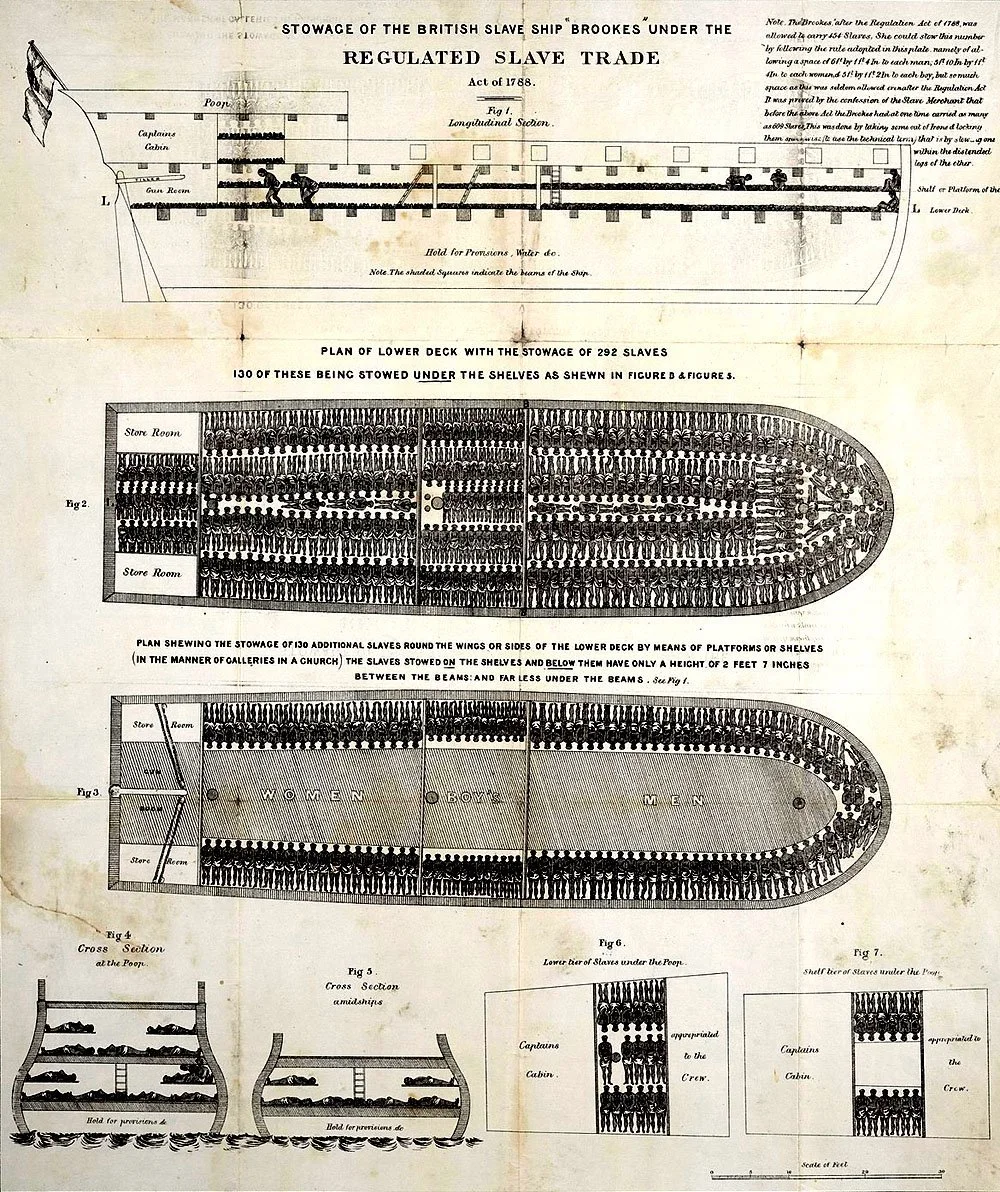
The company was founded in 1711 to help refinance government debt. In 1713 it obtained the asiento contract, which gave it the British right to supply enslaved Africans to Spanish America. Between 1714 and 1739, trafficking enslaved people was its principal commercial activity. On at least 96 voyages, it transported about 34,000 people in appalling conditions and sold them as property.
But a “South Sea Company link” can describe very different relationships:
direct participation in a trafficking voyage;
financing or managing the trading business;
serving as a director or officer;
owning shares in the trading business;
holding a South Sea annuity.
Those categories cannot safely be collapsed.
The company was restructured in 1723. Existing holders of its old stock received two different securities: new shares in its trading business and South Sea annuities. The annuities were perpetual government-debt instruments. They paid fixed interest derived from Treasury payments on government debt, rather than returns from the company’s commercial trade.
Crucially, the two securities could then be acquired and disposed of separately. A later investor might buy South Sea annuities without ever holding shares in the company’s trading business. Queen Anne’s Bounty, for example, made extensive separate purchases of annuities after the restructuring and continued buying them long after it had sold its trading shares.
An annuity holding therefore establishes a connection with a financial arrangement bearing the South Sea name. It does not, by itself, establish that the holder invested in, financed or participated in the company’s trafficking of enslaved people.
The distinction is evidential, not exculpatory. The annuities formed part of a state-finance system connected with the South Sea Company, while the British state itself enabled and protected transatlantic slavery. But that wider historical context cannot convert an annuitant into a shareholder in the trading business—or a “slave trafficker”—without further evidence.
Before describing any South Sea connection, an institution must establish:
What precisely was held? How was it acquired? On what dates? What office, if any, did the person hold? Did that office coincide with the company’s trafficking activity? What does the evidence establish about participation or benefit?
A bare statement that somebody “invested in the South Sea Company” is rarely sufficient. It may conceal direct commercial involvement. It may equally exaggerate an annuity-only connection into participation in slave trading.
What happened at the Church Commissioners
The Church Commissioners’ report did explain the split.
It found that Queen Anne’s Bounty initially held South Sea shares. Those were divided in 1723 into annuities and new trading shares. The Bounty sold its new trading shares by 1730 but continued to acquire and hold substantial annuities.
The controversy arose from what followed.
The report described the annuities as “South Sea Company-linked investments”. It calculated that income from such assets – predominantly annuity interest – accounted for 29.6 per cent of the Bounty’s income to 1793. It also gave modern equivalents for the annuity holdings and considered how the income may have contributed to the Bounty’s accumulated wealth. The Church Commissioners subsequently committed £100 million to a programme of healing, repair and justice.
Richard Dale argued that this approach confused government-debt income with returns from the company’s slave-trading business. He said that the annuity interest came from the Treasury and that the trading shareholders – not the annuitants – bore the profits and losses of commerce.
Alan Lester has disputed that criticism. He argues that the distinction was understood and that concentrating only on the annuities’ immediate cash flow artificially separates them from the institution and state system in which they operated.
This is a genuine dispute about classification, causation and historical meaning. The Telegraph converted it into a much simpler question: was the Church paying reparations “on a false premise”?
That is the practical warning.
A technically complex report can become a front-page allegation that an institution overstated its slavery connection and based reparatory action upon faulty figures.
The opposite risk is just as real. Calling an annuity merely a government bond, without acknowledging the South Sea Company and the state’s role in sustaining slavery, may look like deliberate minimisation.
Every South Sea connection should therefore be tested against six questions:
What was the precise instrument? What legal entity issued or administered it? What role did the person hold? On what dates? Where did the income come from? What will an ordinary reader understand from the proposed description?
A director whose tenure ended before the company transported enslaved people is not in the same evidential position as one who authorised or oversaw voyages. Earlier service may still be relevant because slave trading formed part of the company’s intended purpose. It does not, without more, prove personal participation in trafficking.
A person whose only identified connection was an annuity should not automatically be placed in the same category as someone who financed or managed a voyage.
This is where institutions need particular help: checking that they are neither underclaiming nor overclaiming their South Sea connections.
The legal risk is in the implication
The dead cannot bring defamation proceedings.
That does not make careless descriptions harmless.
Suppose a report calls a deceased person a “slave trafficker” on the basis only of an annuity holding or an inadequately examined directorship. It then identifies a prominent living family or estate and invites readers to conclude that its current wealth and standing derive from slavery.
If that implication about the living person or organisation is false and causes or is likely to cause serious reputational harm, it may be defamatory. The legal question is not confined to whether each isolated fact is accurate. It includes the meaning the publication conveys to the ordinary reader.
An institution that approves, adopts and publishes the report may share responsibility for that publication. Commissioning alone is not the decisive act; control of the content and the decision to publish matter.
That is why descendants and named institutions should normally be notified before publication and given an opportunity to identify errors or material omissions.
This is not a right of veto. It is fairness, accuracy and prudent risk management.
The report will enter the culture wars
Slavery and empire are now proxies for wider arguments about identity, belonging, inherited responsibility and elite authority.
A report may be read by one audience as a long-overdue acknowledgement of injustice. Another will see capitulation to activists, political fashion or imported American arguments.
Our review of highly rated reader comments found the same objections repeatedly:
“The Church of England neglects its parishes. It would help if it focused on this.”
“When does historical liability begin and end?”
“Fifty million are actually enslaved. They got their priorities spectacularly wrong.”
“We are beyond the rage and now just laughing at things like this.”
These comments are not opinion polling. Newspaper readers are self-selecting. But the comments reveal the arguments that will shape coverage: other historical wrongs, institutional purpose, inherited guilt, present-day hardship and modern slavery.
Newspapers do not simply report this debate. They organise it.
The Guardian is likely to ask whether an institution has gone far enough. The Telegraph and Mail will test the evidence, cost, institutional purpose and risk of ideological overreach. The Times is more likely to concentrate on judgement and practical consequence. The Financial Times tends to scrutinise the finance and governance.
A single report may therefore be attacked simultaneously for minimisation and exaggeration.
This is also a civic question
Britain is not at ease with itself.
In September 2025, more than 100,000 people attended the Unite the Kingdom march in London. The event ended in violence in which 26 police officers were injured.
A historical report does not cause civil disorder. That is not the point.
The point is the climate into which institutions publish. Arguments about slavery now connect rapidly with arguments about immigration, national pride, political elites and who belongs.
Traditional institutions are expected to steady civic life. A public body should therefore ask not only, “Is this sentence defensible?” but also, “Does it help people understand a difficult history – or does its language needlessly inflame an existing division?”
That is not an argument for silence. It is an argument for accuracy, proportion and restraint.
Apology is a moral act
An apology should not be inserted automatically into a press release. Nor should it be ruled out before the evidence is considered.
It is a moral act. The institution must know:
what it is apologising for;
what responsibility it accepts;
who is entitled to speak;
to whom the apology is addressed;
what repair follows.
An apology without clarity or consequence can be self-protective. It may transfer attention from the people who suffered to the institution’s performance of contrition.
Repair presents its own ethical difficulty.
Transatlantic chattel slavery was a crime against humanity. No grant or investment fund can make proportionate amends for it. An implicated institution also faces an obvious problem if it calculates its own liability, chooses its own penalty, selects the beneficiaries and then announces that repair has been achieved.
That does not justify doing nothing. It requires serious thought about education, archives, interpretation, restitution, partnerships, grants, investments and present-day conduct—as well as money.
CARICOM’s reparations campaign is active and becoming more organised. Its commission visited Britain in 2025, and CARICOM approved a revised Ten Point Plan in July 2026. In March, the UN General Assembly called for good-faith dialogue on measures including apology, restitution, compensation and rehabilitation.
Institutions identified by new research should expect questions. They should not invent their answers after the journalist calls.
More scrutiny is imminent
Professor William Pettigrew’s Britain’s Slave Traders will be published on 24 September 2026. A related BBC Two series, Britain’s Forgotten Slave Traders, is due in the autumn. His research draws upon about 13,000 identified individuals.
The project’s dataset is intended to be freely available. A City of London Corporation announcement described it as the name-searchable Register of British Slave Traders and said it was due in 2026. The Corporation commissioned separate research intended to complement that wider project; it did not fund the register as a whole.
Historic Royal Palaces and the University of Manchester are also examining Crown engagement in Britain’s emerging empire from Charles II to George III.
Names and connections that once took months to find may soon be searchable by journalists, campaigners and descendants.
The safer route
The answer is not to suppress the research. It is to review the whole publication before release.
The historian, specialist media lawyer and communications adviser should work together. Each asks a different question:
Does the evidence support it?
Is its legal meaning understood and defensible?
Will an ordinary reader take from it what the institution intends?
Is the resulting institutional response ethically coherent?
The review should cover the full report, appendices, definitions, financial categorisation, executive summary, website, press lines, questions and answers, named people and institutions, stakeholder notification, apology and reparations, document control and correction procedures.
No important conclusion should appear in the report without being tested in the public materials. No bold statement should appear in the executive summary unless the evidence beneath it is equally clear.
The work should begin before the historian finishes—not a week before publication.
Precision is not minimisation.
Complexity is not evasion.
Notification is not a veto.
Restraint is not concealment.
The objective is not to make difficult history safe. It is to ensure that what an institution publishes is truthful, humane, proportionate and capable of withstanding scrutiny.
“History, despite its wrenching pain, cannot be unlived, but if faced with courage, need not be lived again.”
— Maya Angelou
About the author
Laura Peek is the founder of Strathem, which advises boards and senior leaders on strategy, communications and critical risk. She began her career as a staff writer at The Times and Daily Mail, reporting from Washington, Cairo, Athens and southern Iraq. She has more than 20 years’ experience advising national institutions and global companies and, since 2020, has worked on projects examining the communication of institutional connections to transatlantic slavery. She studied first-person testimonies of enslaved people as part of her master’s degree.
“Not everything that is faced can be changed, but nothing can be changed until it is faced.”
– James Baldwin